
Our brain controls movements, language, memories, thoughts and emotions. And to function properly, it needs oxygen, supplied via blood through blood vessels. Any interruption in blood supply cuts off the oxygen supply consequently, brain cells die within minutes, thus causing a stroke. The cerebral vascular accident or stroke, also known as a brain attack, is a medical emergency where blood flow to the brain is interrupted, leading to brain damage, long-term disability, or even death.
EPIDEMIOLOGY IN INDIA
Cerebrovascular accident is critical global health issue, ranks as the fourth leading cause of death in India and fifth leading cause of disability. The incidence rate is 119-145 per 100,000 population in urban areas as compared to rural areas. Overall this rate ,prevalence rate and disability rate have increased in past few decades. A significant proportion of strokes occur in individuals younger than 65 years with approximately 20-30% cases occurring in those under 50.In contrast to rural areas, urban population has better outcome due to better access to healthcare facilities, leading to more timely interventions. The mortality rates are influenced by the healthcare access, public awareness and socio-economic status.
TYPES OF STROKE
There are two types of stroke…
1. Ischemic stroke- It is the most common type of stroke; about 80% of strokes are ischemic. It is caused by the blockage of blood vessels via a blood clot in the brain. On the basis of neuroimaging, echocardiography and other investigations TOAST classified Ischemic stroke into five major subtypes :a)Large artery atherosclerosis; b) Cardioembolic; c) Small artery occlusion; d)Stroke of other determined cause; e) Stroke of undetermined cause.
2. Hemorrhagic stroke- When a weak blood vessel ruptures and bleeds into the brain, it is known as a hemorrhagic stroke. About 20% of strokes are hemorrhagic on the basis of bleeding site hemorrhagic stroke are of two types: a) Intracerebral hemorrhage- when bleeding is within the brain parenchyma ;b) Subarachnoid hemorrhage- when bleeding is between the meninges of the brain.
There is an entity known as Transient Ischemic Attack (TIA), warning stroke or mini-stroke, caused by a blockage in a blood vessel that breaks up before it damages the brain. The symptoms disappear within an hour or may last up to 24 hours. It is a warning sign for future strokes.
RISK FACTORS AND CAUSES
80-90% of all strokes are caused due to following factors:
a) Hypertension
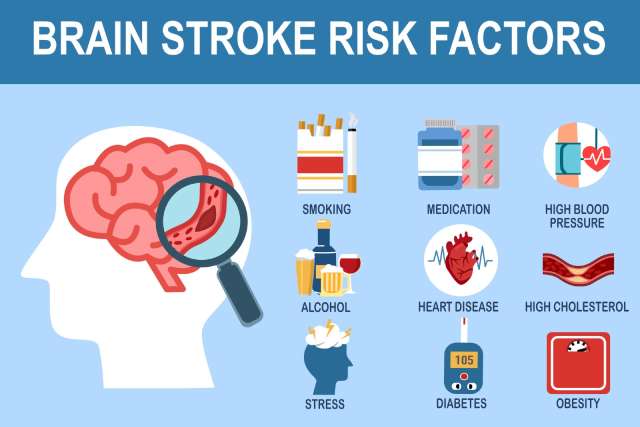
b) Obesity
c)Physical inactivity
d) Smoking
e) Old age
f) Unhealthy lifestyle
g) anxiety, depression, high stress level
h) family history and genetics like blood type AB
Other causes:
Ischemic strokes are caused due to coronary artery disease, atrial fibrillation, valvular disease whereas hemorrhagic stroke are caused due to blood thinners or rupture of aneurysms.
SIGNS & SYMPTOMS
a) One sided body numbness including face, arm, leg
b) Sudden onset of confusion, trouble speaking, difficult understanding speech.
c) Sudden onset of blurring or decreased vision
d) Sudden onset of trouble in walking, dizziness, imbalance , lack of coordination.
e) Sudden onset of severe headache.
If you think any person is having above symptoms than BEFAST and do the following:
B-Ask the person to walk .Look for loss of balance while walking or lack of coordination
E- Ask for any difficulty in vision. Look for any sudden loss in vision.
F- Face- Ask the person to smile. Look for any face drop.
A-Arms-Ask the person to raise Arms. Look for the drifting of any arm.
S- Speech- Ask the person to repeat the phrases.Look for slurring of speech
T-Time- If any of the above signs present then immediately call for the help(108).
But if the symptoms fades off within few minutes, the person may have transient ischemic attack(TIA). Many people ignore it,as it clear up in few minutes.But actually, it is a sign of a serious condition that will not go away without medical help.
DIAGNOSIS OF STROKE
NCCT Brain and MRI
Treatment and Management Of Ischemic Stroke
The mainstay of treatment is to restore the blood flow to the compromised area and optimizing collateral flow. The treatment may include reperfusion therapy and long-term management.
A) Reperfusion therapy- In order to restore the blood flow lysis of the clot is done using the drug tissue plasminogen activator(tPA). It can be given up to 4.5 hours of the onset of symptoms. The sooner the treatment begins better the chances of recovery. Alternative to tPA is Tenecteplase.
B) If there is large vessel occlusion then one can go for mechanical thrombectomy. It can be done within 6 hours of onset of the stroke symptoms.
C) LONG TERM MANAGEMENT
To prevent future strokes, one has to continue with antiplatelets like ecospirin and anticoagulants like clopidogrel.
Treatment & Management of Hemorrhagic Stroke
The mainstay of treating the hemorrhagic stroke is to stop the bleeding, reducing the intracranial pressure, treat the underlying cause like hypertension, aneurysm, arteriovenous malformation, reversing the blood thinners. The various surgical procedure are being done to treat the cause like decompressive craniotomy for intracerebral bleed, coiling and clipping for aneurysm.
In conclusion, stroke, an emergency medical condition, a leading cause of disability and death worldwide. It has devastating consequences for individual, families and society. However, with early detection, timely intervention and rehabilitation many stroke survivors can regain function and improve their quality of life.
Resources
National institute of neurological disease and stroke
Centres for disease control and prevention(CDC)
National Heart, Lung and Blood Institute(NHLBI)
Pingback: SMOKING !!- Nature’s Way Of Thinning The Herd - healinghealth.fun
Pingback: Eclampsia - A public health challenge in pregnancy care
Pingback: Obesity, a health burden
Pingback: बचपन का खतरा – रूमेटिक हार्ट डिजीज से कैसे बचे ? - healinghealth.com