Introduction
A balanced diet is defined as nutritionally adequate and appropriate intake of food items that provide all nutrients in required amounts and in proper proportions. A balanced diet ensures normal growth, development, optimum health.
Malnutrition is a serious condition used to describe a deficiency , excess, or imbalance of wide range of nutrients resulting in a measurable adverse effect on body composition, function and clinical outcome. It addresses three broad groups, i.e. UNDERNUTRITION, MICRONUTRIENT RELATED MALNUTRITION, OVERWEIGHT/OBESITY/DIET RELATED NON-COMMUNICABLE DISEASES.
Epidemiology of Malnutrition in India
During the initial 6 months of life, 20-30% of childern already undernourished due to their low birth weight and inadequate breastfeeding. The stunting rate climbs rapidly after 6 months of age due to inadequate complementary feeding and after 6 months child is prone to infectious diseases like diarrhea.
The 3 cardinal determinants of undernutrition are low birth weight, infections, low food intake. About 20% of childhood undernutrition is attributable to fetal growth restriction. Diarrhea, pneumonia and other infections increase energy expenditure and hamper growth. About 25% of undernutrition is attributable to these infections. About 55% of undernutrition is due to low food intake like inadequate breastfeeding and complementary feed.
According to Global hunger Index 2023, India stands at 111th out of 125 countries with a score of 28.7 indicating serious level of hunger. India has highest child wasting rate in the world at 18.7%. And 35.5% childern under five are medically listed as having their growth stunted, a condition that leads to long term development complication. As per NFS-5(2019-2021), stunting, wasting, underweight has reduced from 38.4% to 35.5%, 21% to 19.3%, 35.2% to 32.1% respectively. The malnutrition in reproductive age group (15-49 years) has also declined from 22.9 to 18.7 %.
Causes of Malnutrition
- Inadequate diet intake, inadequate breastfeeding
- Poor nutrient absorption e.g crohn’s disease, celiac disease
- Increased metabolic demand like in pregnancy, breastfeeding women
- Chronic diseases like chronic liver failure, chronic kidney disease, tuberculosis, chronic smoker
- Certain psychiatric disorders like depression, dementia, anorexia nervosa causing loss of appetite thus malnutrition.
- Low socioeconomic status limits the access adequate nutritious food.The rate of undernutrition children is higher in rural areas as compared to urban region. And among schedule caste and tribes the figure rises to 53% and 55% respectively.
- Inadequate health care and poor mother nutrition directly contribute to undernutrition to children.
- Low birthweight and inadequate breastfeeding lead to growth complication and weak immunity.
- Poor sanitation and lack of access to clean water leads to repeated infections like diarrhea or intestinal infections. This causes inadequate absorption of nutrients from the gut, thus, increase chances of chronic illness hence causing undernutrition.
UNDERNUTRITION
It is a set of condition that result from inadequate consumption, poor accretion or excessive loss of nutrients. Undernutrition can be divided into 3 subtypes.
| Underweight | Wasting | Stunting |
| Low weight for age Child can be wasted or stunted or both | Low weight for height Thin appearance Acute undernutrition due to recent food deficit or acute illness | Low height for age/ Short for age Chronic undernutrition.
|
Clinically undernutrition can be classified as Marasmus, Kwashiorkor and Marasmickwashiorkar.
Marasmus
Marasmus is associated with severe form of wasting of fat and muscles. It indicates acute starvation or acute illness .It present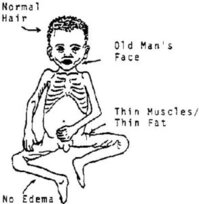
s as severe wasting, wasting of shoulders, arms, thighs, buttocks , loss of buccal fat, loss of fat from buttocks giving it a baggy pant appearance. Childern are alert inspite of their condition.
Kwashiorkor
Uncommon in India. Mainly seen in 1-4 years of age. Pitting edema, fatty , sugar baby appearance are its charact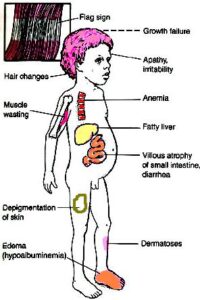 eristic features. Muscle wasting is present but not evident due to edema. Child is weak, hypotonic, lethargic. Other systemic invovlement can be present.
(fig by Hallgier kismul)
Treatment
Mild and Moderate malnutrition are managed on ambulatory basis while severe form of malnutrition is managed in hospitals. The mainstay of treatment is adequate amount of protein and energy. At least 150 kcal/kg/day or additional 25 kcal/kg/day should be given. Nutritious home food is recommended. A protein intake of 3/kg/ day is recommended. Advice to have high energy intake, frequent feeding(at least 5-7 times a day). According to WHO, animal source food like milk and eggs are likely to meet the amino-acid demand while legumes and cereals are good sources of proteins. The best measure of efficacy of treatment is weight gain.
Government has implemented several schemes like Anganwadi Services Scheme for adolescent girls and Pradhan Mantri Matra Vandana Yojana (PMMVY) under the Umbrella Integrated Child Development Services(ICDS). Anganwadi services aims to improve the nutrition and health status of pregnancy and lactating mothers. Under the scheme they provide supplementary nutrition, nutrition and health education, immunization, health checkup and referral services.
In 2018, POSHAN abhiyan was launched which aims at the nutrition and healthcare of adolescent girls, pregnant females, lactating mothers in a time bound manner by adopting a synergized and result oriented approach. But now new program Mission Poshan 2.0 have been announced in 2021 which mainly focuses on the diet diversity, food fortification, popularizing use of millets. Under supplementary nutrition programme of aganwadi services now, fortified rice are allocated in all the states. As per the Mission Poshan 2.0 guidelines, millets need to be mandatorily supplied at least once a week and suitably integrated in Take Home Ration (not raw ration) and Hot Cooked Meals in a palatable form. Other key components for Misson Poshan 2.0 is Poshan Abhiyan which focus on social and behavioral change communication (SBCC)to address inadequate and inappropriate infant and young child feeding practices, nutrition and care during pregnancy and adolescence. Community Based Events or CBEs are organized every month at Anganwadi centers (AWC) and primarily focus on promotion of maternal nutrition (Godhbharai) and/ or initiation of appropriate complementary feeding (Annaprasan).
At the national level, the Rashtriya Poshan Maah is celebrated in the month of September across the country, while Poshan Pakhwada is celebrated in the month of March. During Poshan Maah 2022, themes like Mahila aur Swasthya, Bachcha aur Shiksha, Gender Sensitive Water Management and Traditional Food for Women & Child were especially emphasized upon. Around 80% of activities reported were focused on the key theme of ‘Mahila aur Swasthya, which included awareness drives on Anemia prevention, Anemia testing, camps on appropriate breastfeeding practices etc.
Malnutrition is a global health challenge that effects millions, regardless of age or geography. It effects the health, development and economic productivity. By raising awareness at every level from individual to government we can move toward a better world where everyone lead a healthy and nourished life.
Resources
- Book – Essentials of Pediatric medicine by O.P. Ghai
- Malnutrition free India
- Government Scheme- Mission Poshan2.0
- Diet and Kwashiorkor in the Democratic Republic of Congo