Introduction
Common mental disorders mainly refer to two main categories, i.e., Depressive Disorders and Anxiety Disorders. These disorders are highly prevalent in the population. Anxiety is a state of unease or worry, nervousness, and fear often accompanied by breathlessness and restlessness. On the other hand, Depression is a serious mental disorder characterized by a low mood, loss of interest or pleasure in activities for a long period.
Epidemiology of Depression in India.
In India, at least 57 million people(18% of the global estimate) affected by depression. According to 2015, National Mental Health Survey 1 in every 20 Indians or 5.3% of population was found to have suffered with depression once in their lifetime. They also revealed that 15% of Indian adults require active interventions for mental health issues. An analysis in collaboration with leading data science professionals showed that the incidence of depression has been doubled since 2018 peaking in 2020 with onset of COVID-19. In 2021 UNICEF survey reported 14% of 15-24 years old or 1 in 7 people in India had feeling of depression.
The rate of depression is higher among older women as compared to older men as older men are reported to be physically active than women. The older women are widow, never worked, socially inactive and receive ill treatment from members within or outside the family. Hence, not satisfied with the life. So, they are more prone to depression.
Depression is common in elderly people with dementia and Alzhimer’s disease. Dementia can cause same symptoms as depression and sometimes depression can be early warning sign of dementia. Although depression is not related to aging but their health and changes of circumstances in life put them at increased risk of depression. According to CDC, approximately 4% of elderly over 70 years of age have depression.
10% of women experience depression during pregnancy or during postpartum period. More than 7,00,000 people die due to suicide every period .Hence it is the fourth leading cause of death worldwide in 15-29 years of age. The lifetime prevalence of MDD is 10-25% for women and 5-12% for men. The average age of onset of depression is 31.9 years in India.
SYMPTOMS
Depression symptoms vary in severity and most commonly includes:
- Emotional symptoms : low mood, sadness, irritability, hopelessness, loneliness, feeling of worthlessness, anhedonia
- Cognitive symptoms: difficulty in concentration, taking decisions, negative thinking, suicidal thoughts
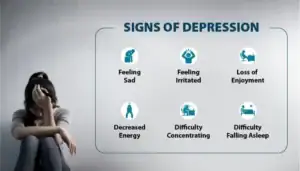
- Physical symptoms: change in appetite, change in sleeping pattern, fatigue and tiredness, unexplained body ache and pains, slowed speech or movements.
- Behavioral symptoms: withdrawing from social interactions, decreased performance at the workplace, neglecting personal hygiene and responsibilities, substance abuse as coping mechanism.
If any of the above symptoms persist for more than two weeks than seek the help of a healthcare personnale or a psychiatrist.
RISK FACTORS
A risk factor is something that increases the chances of developing a disease. The exact cause of depression is not known but various factors can be involved. Some are discussed below:
- Family history and genetics- Parent or sibling with depression in the family increases the chances of having depression 2-3 times.
- Brain chemistry – Neurotransmitters like serotonin, dopamine play a significant role in mood stability. Thus, they likely play a role in depression.
- Hormones – An imbalance in body’s hormones can cause depression like during and after pregnancy, thyroid disorders, menopause, etc.
- Psychological factors- trauma in childhood, chronic stress, low self -esteem.
- Environment factors – Physical abuse, violence, poor social support, cultural or societal pressure. poverty, experiencing social disadvantage.
- Others- Chronic medical illness(like diabetes, heart disease) , some drugs like steroids, alcohol and other drug abuse.
Stages of depression
There are 5 stages of depression. These stages were introduced by Kubler Ross. He emphasized that the stages of depression are not linear and not all patient will go through every single stage. These stages are : Denial, Anger , Bargaining, Depression, Acceptance.
Treatment of Depression
Management of depression includes combination of therapies and lifestyle changes. The approach depends on the severity of the patient.
Therapies included :
- Medical therapy: It includes medications like antidepressants, SSRIs, tricyclic antidepressants.
- Psychotherapy: It includes talk therapy like cognitive behavior therapy(CBT).
- Brain stimulation therapy: Includes electro convulsion therapy (ECT).
- Life style changes: Exercise, healthy diet, sufficient sleep, social interaction, avoid alcohol and abusive substances.
Resources
- Depression in India by Press Information Bureau(PIB)
- Depression and older adults (National institute on Aging)
- Depression and aging (CDC)
- World health organization
- Indian Journal of Psychiatry
Pingback: Obesity, a health burden