
What is Breastmilk?
Breastmilk or human milk is the milk produced by the mammary glands in the breast of women. It is the primary source of nutrition among newborns. WHO/UNICEF recommends 6 months of exclusive breastfeeding among newborns. The alternative to human milk is formula milk.
Types of breastmilk?
Throughout the lactation period, breastmilk varies with three distinct phases: colostrum, transitional milk, and mature milk.
Colostrum: It is the first milk of the mother, and lasts for a few days. Also known as ‘liquid gold’, as yellow in colour and rich in nutrients, fat, protein, and antibodies. It acts as a laxative for newborns.
Transition milk: Approximately two to three days after the birth of the baby, transition milk replaces the colostrum. It is thin in consistency and rich in protein, lactose, calories, and fat.
Mature milk: After 10-15 days of the baby’s birth, production of mature milk begins. It’s very thin in consistency as it is rich in water content. It often appears bluish at the beginning of the feeding (foremilk), and turns white toward the end of the feeding (hindmilk) as the milk’s fat content increases. The consumption of hindmilk is essential to ensure the baby is getting adequate nutrition.
What makes it so special?
It is the irreplaceable source of nutrition in the early days of life. It contains 87-88% water, 124 g/L macronutrients, which include 7% (60-70 g/L) carbohydrates, 1% (8-10 g/L) protein, and 3.8% (35-40 g/L) fat. Colostrum is low in fat but high in protein, especially whey and casein. It is rich in immunoprotective components like IgA, lactoferrin. Human breast milk is rich in growth factors, microbes, and microRNAs, which are essential for to development of the newborns. Lactose is the major carbohydrate constituent of the breastmilk. Fat is the second-largest component of human milk. It contains 2 essential fatty acids, i.e., linoleic acid and alpha-linolenic acid, which further break down and form docosahexaenoic acid(DHA). DHA is important in the development of the central nervous system and
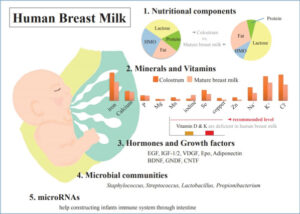
d human milk is the only source for it. The level of DHA in human milk is low among vegetarian mothers as their diet lacks fish and other sources. The human milk is deficient in vitamin D and K.Hence, it is advised to give supplements of vitamin K and sun exposure for vitamin D.
RESOURCES
Pingback: Breastfeeding - healinghealth.com